
Byk Epoxy Sl 9202-2K
Solvent Free Self Levelling Coating

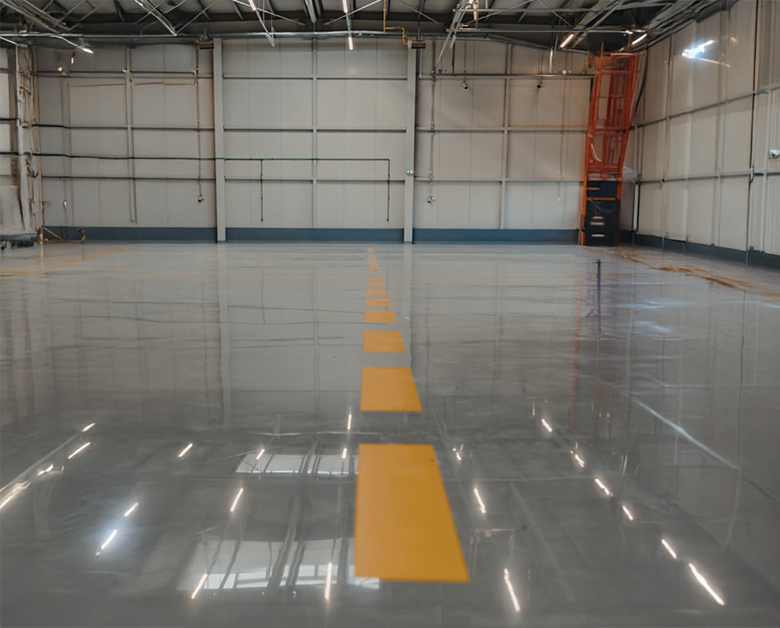
BYK EPOXY SL 9202–2K it is a solvent-free, self-leveling, epoxy-based coat material with high mechanical strength and chemical resistance.
Places of Usage
• Factories, warehouses, shopping malls, aircraft hangars,
• Schools, hospitals, pharmaceutical industry, food industry, laboratories, parking lots,
• Wastewater treatment plants, areas where heavy forklifts and corrosive
chemicals are useds
Advantages
• Resistant to chemicals.
• Resistant to abrasion and friction.
• It is hygenic, doesn’t require long term maintanence.
• Easy to apply and clean
• Solvent free
Technical Specifications
Density ( Mixture) |
1,45±0,05 gr/cm³ 20 °C TS EN ISO 2811-1 |
Solid Content (%) |
100 By weight |
Shore D |
75-80 (7 gün sonunda) |
Diluting |
Not recommended |
Mixing ratio (A/B) |
19/5 |
Pot Life |
30-40 min /23 °C, 200 g. DIN 16945 |
NOTE: Flammable and exploision products should be kept away during the application. Protective gloves and masks should be used for hands and eyes during application. The product should be used in well ventilated environments.If the material comes into contact with eyes, it should be washed immediately with su¬cient water. Childrens should kept away from the product. For more detailed information, ask for the Safety Data Sheet (MSDS).
Curing Time
Temp. |
Pedestrian Traffic |
Mechanical Strength |
Chemical Strenght |
| +10 oC | 72 hours | 5 days | 10 days |
| +20 oC | 24 hours | 4 days | 7 days |
| +30 oC | 18 hours | 2 days | 5 days |
Recoating Time
Temp. |
Pedestrian Traffic |
Mechanical Strength |
| +10 oC | 30 hours | 3 days |
| +20 oC | 24 hours | 2 days |
| +30 oC | 16 hours | 1 days |
Chemical Resistance Table
Chemical Name |
Result |
| Sulfuric Acid (H2SO4) 10% | 3 |
| Sulfuric Acid (H2SO4) 20% | 3 |
| Hydrochloric Acid (HCL) 10% | 3 |
| Hydrochloric Acid (HCL) 20% | 3 |
| Nitric Acid (HNO3) 10% | 3 |
| Nitric Acid (HNO3) 20% | 2 |
| Sodium Hydroxide (NaOH) | 3 |
| Xylene | 3 |
| Ethyl Alcohol | 3 |
| Solvents | 3 |
Mechanical Strenght
| Compressive Strength (N/mm2) (DIN EN 196) | ~50 |
| Adhesion Strength (N/mm2) (EN 1542, EN ISO 4624, EN 12118) | >3 (Concrete Surface) |
| Flexural Strength (N/mm 2) (DiN EN 196) | ~25 |
| Shore D | 75-80 |
| Abrasion Resistance (DIN 53 109 (Taber Abrasion Test) | 70mg ((CS10/1000/1000) (8days23oC) |
Application Procedures
Mixing Ratio
A/B =19/5 (by weight)
Mixing
Component A is mixed with a low speed (300-400 rpm) mechanical mixer until it becomes homogeneous. Component B is then added to component A and the mixture is mixed continuously for 2 minutes until it becomes homogeneous. Avoid over-mixing to minimize air entrainment.
Application Conditions
Please check the relative humidity and dew point before application. If the conditions are suitable, start the application. Solvent-free epoxy SL is poured onto the primed surface and spread on the surface by a notched trowel. Then, a spiked roller is passed over it to remove the entrained air. The prepared mixture should be consumed within a maximum of 40 minutes. Repair and leveling operations are carried out at least 8 hours after the previously applied epoxy primer.
Surface Preparation
For Metal Surfaces: In order to achieve top level performance, sandblasting should be done at Sa 2 ½ level.The sandblasted surface should be primed with a dust rich epoxy primer or phosphate rich epoxy primer to form the required dry film before recording product identification information.
For Concrete Surfaces: The concrete surface must be clean, solid and have sufficient compressive strength (>25N/mm2), and tensile strength must be >1.5N/mm2. The concrete floor to be insulated must be solid and there must be no movement on the surface. The grout layer on the surface must be removed. The concrete to be insulated must be at least C25 and preferably C30 – C35 standard.
Concrete Standards: The surface should be cleaned with pressurized water and freed from oil, grease, dirt, mortar particles and dust. Concrete surfaces should be prepared to obtain an open porous surface by removing cement grout using abrasive equipment.It should also be completely cleaned from mold release agents, cement residues, shavings, loose particles and uncured membranes. The grout layer on the surface must be removed. (Shot-Blast, Rota Tiger etc.) If the surface is too shiny, it should be roughened with milling or sandblasting. Concrete cracks should be cut in a V shape, cleaned and false joints should be cleaned.
| Surface Temperature | Min + 10 °C / Max + 30 °C |
| Ambient Temperature | Min + 10 °C / Max + 30 °C |
| Material Temperature | Must be between + 10 °C and + 30 °C. |
| Surface Moisture Content | The moisture content in the concrete must be max. 4%. |
| Relative Humidity | Must be max. 80% |
| Dew Point | The ground temperature must be at least 3 oC above the dew point during application. |
Application Restrictions
Please do not apply the product on the high moisture surfaces.Freshly applied BYK EPOXY SL should be kept away from moisture, condensation and water for at least 24 hours.Weak and dirty areas cannot be covered with thin coatings. For these reasons, both the surface and the adjacent areas should always be prepared for application and cleaned thoroughly before application. In order to have color match in the coating ,the same batch numbered buckets should be applied in same area. If it is necessary to heat the environment, use electric systems. Fossil fuel systems affect the surface appearance. BYK EPOXY SL shouldn’t been exposed to sunlight, it will loose its mechanical properties.The product should be brought to the application area 1-2 days before in order to get suitable application conditions.Resin based epoxy systems’ service time is related to the relative humidty , temperature and moisture of the surface. At low temperatures, the chemical reaction slows down, which extends the usage time, the coating time and the working time. At the same time, consumption increases as the viscosity increases. High temperatures increase the speed of the chemical reaction and the times described above are shortened accordingly. For complete curing the ambient and ground temperatures should not fall below the minimum allowed temperature. After the application is completed, the coating should be protected from direct water contact for at least 24 hours. If there is contact with water, this will cause carbonation and softening on the coating and this will cause the coating to lose its properties. In such a case, the entire coating should be removed from the ground and renewed.
Packaging
Consumption
Shelf Life
Safety Precautions
Responsibility
Adhesive Group is a cement-based, ceramic adhesive material with reduced slip feature, that can be used both indoors and outdoors, horizontally and vertically.
