
Byk Pu Seal 600
Polyurethane Based Expansion And Joint Sealant
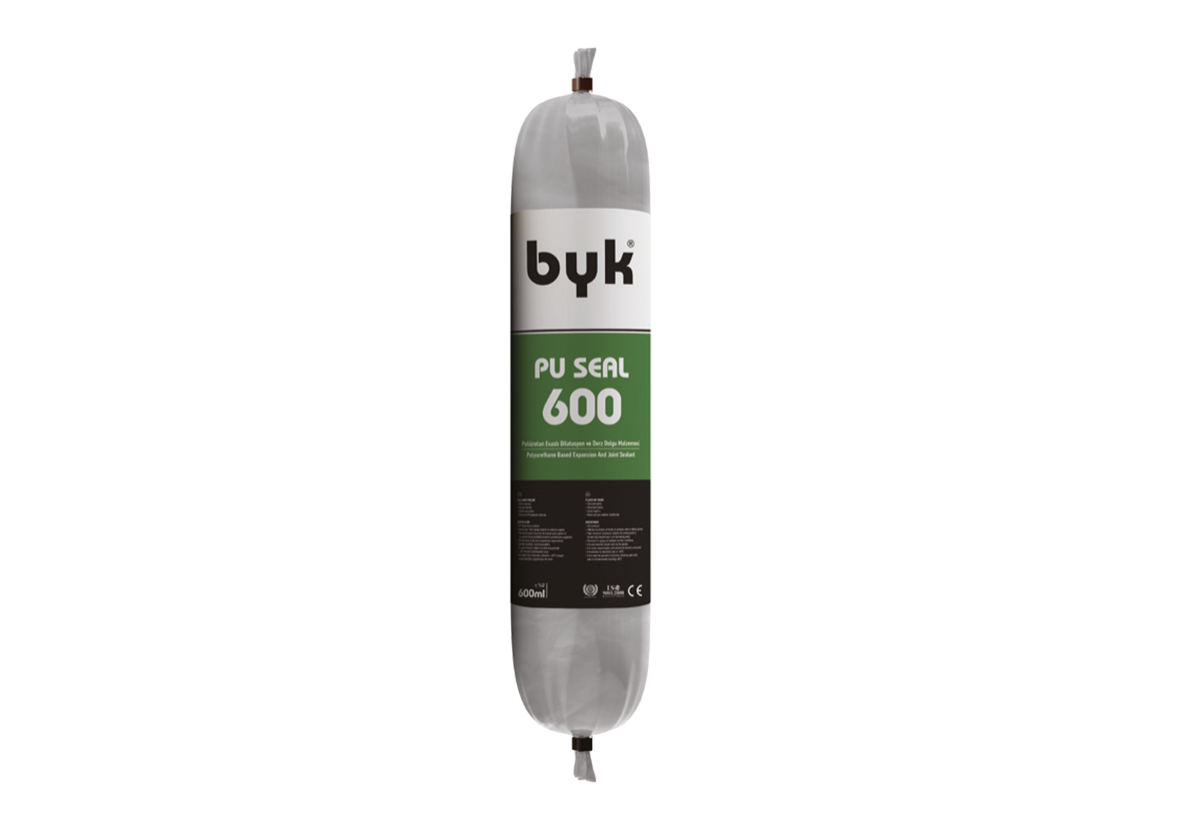
BYK PU SEAL 600 is a single component polyurethane sealant which cures with moisture on the air
Places of Usage
• Concrete joints
• Structural joints
• Crack repairs,
• Wood and pvc window installation
Advantages
• UV resistace
• Adheres to almost all kinds of surfaces, with or without primer.
• High chemical resistance, suitable for sealing joints in chemically treated water and swimming pools.
• Resistant to aging and outdoor weather conditions.
• It is permanently elastic and can be painted.
• It is water impermeable and resistant to bacteria and mould.
• It maintains its elasticity even at -40°C.
• It has high temperature resistance, allowing application even in environments reaching >60°C

Technical Specifications
Color |
White,Gray | - |
Density |
1,40 g/cm3 | ASTM D1475 / DIN 53217 / ISO 2811, @ 20oC |
Drying Time |
2 hour | ASTM D 2196-86 / EN ISO 3219 (+25°C) |
Curing Rate |
3-4 mm/day | - |
Usage Temperature |
15°C /+30°C | - |
Service Temperature |
- 40°C /+80°C | ISO 7389 |
Shore A |
~25 | ASTM C661 |
Elongation |
>900 % (Dumble Test) | ASTM D412 |
Adhesion to Concrete |
≥2 N/mm² | EN-ISO-8339 |
NOTE: The technical specifications listed above are based on tests conducted at 23°C and 50% relative humidity. Values may vary under different temperature and humidity conditions.
Consumption
WIDTH DEPTH (mm) |
3mm |
6mm |
8mm |
10mm |
| 3 | 66.6 | 33.3 | 25 | 20 |
| 6 | 33.6 | 16.6 | 12.5 | 10 |
| 8 | 25 | 12.5 | 9.3 | 7.5 |
| 10 | 20 | 10 | 7.5 | 6 |
Application Procedures
Surface Preparation
The application area must be smooth, clean and free of all moving parts. Residues such as dirt, oil and paint should be cleaned from the surface with appropriate methods. Surfaces with high oil absorption should be completely renewed and repaired with BYK EP MORTAR 9301-2K Epoxy based repair mortar. If the application surface is concrete, class should be minimum C25, relative ambient humidity should be below 85%, and ambient temperature should be between +15°C and +30°C. When the temperature of very porous substrates, such as cracked or poorly compacted concrete, rises, the pore bonding surfaces must be filled properly to prevent air bubbles that may form in the mastic that has not yet been cured. Direct application on unstable substrates is not recommended. In such cases, the bottom layer should be primed before application with a primer material selected according to the surface type and moisture condition, in order to ensure the formation of a durable and permanent bottom layer that strengthens the concrete.
Application
Apply materials such as open-cell polyurethane or closed-cell polyethylene support wicks. Although both types of support wicks are suitable, when using closed-cell polyethylene, care should be taken not to puncture the outer coating of the wick as bubbles may form if the temperature rises. The wick, which functions as a fixed support in case the mastic cannot be corrected with a tool, is important in terms of the correct ratio of width to depth in practice. Slide the sealant into the application gun, cut off the very end of the sealant packaging, and insert the gun with the nozzle cut to get the correct drop size. Squeeze the mastic into the joint, making sure there is no air left. In wide joints, more than one pass of gun application is required to ensure full contact of the mastic with the edges and bottom. After application, smooth it immediately with a spatula. The ratio of width to depth should be 2:1, provided that the minimum depth is 10 mm. The product should not be exposed to chemicals before its final cure is completed.
Matters to be taken into consideration
• The materials to be used must be brought to the application site 1-2 days in advance and must adapt to the
environmental conditions.
• Rain, dust, wind, animals and insects should be prevented from entering the building while the coating is fresh.
• Consumptions are given for ideal conditions where the ambient and surface temperature is assumed to be 20°C. Actual
consumptions may vary depending on the surface structure. It should not be forgotten that damaged surfaces will
increase consumption.
Packaging
Shelf Life
Safety Precautions
Responsibility
Adhesive Group is a cement-based, ceramic adhesive material with reduced slip feature, that can be used both indoors and outdoors, horizontally and vertically.
